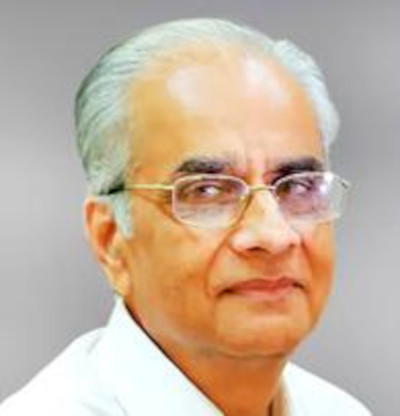
K. Jayakumar, IAS (Retd.)
Former Chief Secretary Government of Keralam
K. Jayakumar is an administrator, poet, translator, lyricist, columnist, and artist. He joined the Indian Administrative Service (IAS) in 1978 and served in various capacities in the Government of Kerala and the Central Government. Major assignments include District Collector, Kozhikode, Director of Tourism, Director of School Education, Secretary of several Departments like Education, Culture, Tourism, Devaswom, Water Resources, Agricultural Production Commissioner and, Home Secretary. He Served as Joint Secretary in the Ministry of Culture from 2002-2007. He retired as the Chief Secretary of Kerala in 2012. He serves as the President of the Travancore Devaswom Board at present. Author of forty books in Malayalam, and nine works in English. He has translated Tagore, Rumi, Kabeer and Kahlil Gibran into Malayalam and Gita Govindam into English. Wrote lyrics for over a hundred films, besides several songs, and music albums. Among the scores of awards, Central Sahitya Akademi Award for Malayalam Poetry in 2024 , Kerala Sangeet Nataka Academy Award for drama lyrics and Kerala Sahitya Academy award for overall contribution to Malayalam literature merit mention. He is an artist having held nearly 20 solo exhibitions in India and abroad.
Session 2D – Public Lecture
Chairperson: Raghavan Varadarajan, President, IASc
Has the Kerala Model of Development Outlived its Relevance?
Hailed for its emphasis on human resource development and social equity, Kerala model of development has succeeded in a social engineering that has welfare at its core. Successive governments, regardless of their ideological differences, believed that it is the moral imperative of the state to directly provide quality and affordable education and healthcare to its citizens. Several pension schemes for the vulnerable sections became an accepted feature of governance. With the 73rd, 74th Constitutional amendments, the local bodies became more empowered than ever before. They got the power to directly deal with schools snd government hospitals. The local governments too continued with the same ethos. However, after liberalisation and privatisation of the Indian economy, we have been witnessing the gradual receding of the state from several crucial sectors. This policy that is the hallmark of today's national economic policy and growth idiom has thrown several challenges to the welfare ethose of the Kerala model . will liberalisation be able to offer the welfare cusion to the citizens as the state would ? Or is the claim of welfare administration a luxury with Kerala's debt rising every year. All over Europe and elsewhere, the capitalist logic of market-led economic growth and trickle down effect are facing increasing threat. Will this validate the Kerala model or will the Kerala model undergo mutation to retain its relevance? One thing us certain: the benefits to society which the Kerala model could provide are still beyond the reach of liberal economics where the state has no direct role.